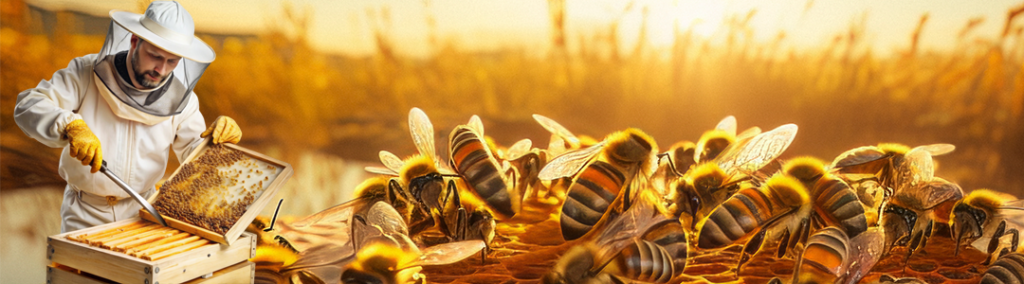
Among different insect orders, only 8 have been recognized by insect taxonomists which have some communal life. Out of these 8 orders only two orders viz. Isoptera and Hymenoptera have well developed social organization. Even in Hymenoptera, only two families namely Halictidae and Apidae of superfamily Apoidea contain fully social species. Most of other bees live solitary life. Social behaviour Honey bees are among the fully social insects having overlap of many generations in the same nest. The colony is a well organized social group having division of labour in terms of laying of eggs, nursing, comb building, guarding, food collection and its storage. They have well developed communication system through different types of dances as well as trophallaxis.

Biological communication can be defined as an action on the part of one organism that alters the probability pattern of behavior in another organism in an adaptive fashion. Adaptive means that the signaling or the response or both which have been genetically programmed to some extent by natural selection.

Trophallaxis is food transmission (exchange of food) which is common between workers and also from workers to queen and drones. It is a sort of communication regarding availability of food and water and also a medium for transfer of pheromone. In honey bees, recruit communication is very important mode of communication which is defined as a communication that brings nest mates to some point in space where work is required. Dances of honey bees are important recruit communication.

Related Post

  • |

    Innovative Bee Nutrition Solutions: Feeding the Future of Beekeeping

    🌼 The Buzz About Bee Health In recent years, beekeepers around the world have faced one overwhelming challenge: keeping their bees alive and thriving. Between environmental stressors, pesticide exposure, and dwindling natural forage, honey bees are struggling to get the nutrients they need. That’s where innovative bee nutrition solutions step in — not just as supplements, but as lifelines for the future of beekeeping. 🍯 Why Nutrition Matters More Than Ever Healthy bees require a balanced diet rich in protein, lipids, and micronutrients—primarily sourced from pollen. But with monoculture farming, climate change, and habitat loss reducing natural floral diversity, bees are often left hungry or malnourished. Poor nutrition = weaker bees = higher colony loss.It’s a simple equation with devastating consequences. 🧪 Pollen Substitutes: A…

  • |

    How to Start Beekeeping in India 2025 | Step-by-Step Guide to Honey Business

    How to Start Beekeeping in India — 2025 beekeeping business in India how to start honey bee farming honey production in India government schemes for beekeeping beekeeping training in India apiary setup guide Apis mellifera vs Apis cerana beekeeping equipment list honey export from India NBHM subsidy 2025 परिचय — क्यों अब मधुमक्खी पालन (Beekeeping)? मधुमक्खी पालन भारत में एक लाभकारी, तुलनात्मक रूप से कम भूमि-आधारित व्यवसाय है। यह छोटी-छोटी भूमियों पर भी किया जा सकता है, श्रम-समावेशी है (महिलाएँ और युवा आसानी से जुड़ सकते हैं) और कृषि उपज के लिये परागण (pollination) के रूप में भी महत्त्वपूर्ण योगदान देता है। 2020s के दशक में भारत में सरकारी प्रोत्साहन और निर्यात बाजार में वृद्धि ने इसे और आकर्षक बना दिया है — इसलिए 2025…

  • Economical value of Bee Keeping

    वाणिज्यिक मधुमक्खी पालन का आर्थिक मूल्य संयुक्त राज्य अमेरिका में कृषि एक प्रमुख उद्योग है जिसका हर बारह नौकरियों में से एक से सीधा संबंध है। बीसवीं सदी की शुरुआत से, ‘प्रवासी’ मधुमक्खी पालकों ने यू.एस. फसलों की एक विस्तृत विविधता को परागित करने के लिए मौसमी रूप से अपने छत्तों को स्थानांतरित करके कृषि। वाणिज्यिक मधुमक्खी पालन प्रत्येक वर्ष कृषि के लिए $15 और $20 बिलियन का आर्थिक मूल्य जोड़ता है। उपज के बिना वाणिज्यिक परागण सेवाओं से संभव हुई वृद्धि, खाद्य कीमतों में वृद्धि होगी, हमारे कृषि क्षेत्र विश्व स्तर पर तेजी से कम प्रतिस्पर्धी बनते हैं, और हमारी खाद्य आपूर्ति की सुरक्षा और विविधता होगी कम करना। जंगली कीट परागणकों की आबादी पहले से ही गंभीर गिरावट में है । मधुमक्खी पालन…

  • मधुमक्खी पालन शुरू करने का सही समय

    मधुमक्खी पालन व्यवसाय एक बहुत ही अच्छा व्यवसाय है जिसे कोई भी कर सकता जिसमें लागत कम लगती है और लाभ लिया जा सकता है। जो साथी इस काम को शुरू करना चाहते हैं उनके दिमाग में बहुत से प्रश्न होते हैं उनमें सबसे महत्वपूर्ण है कि हम इस काम को कब शुरू कर सकते हैं ताकि लाभ अधिक हो और नुकसान कम हो। वैसे तो इस व्यवसाय को कभी भी शुरू किया जा सकता है परंतु जिस समय प्रकृति में फूलों का खिलना शुरू होता है वो समय सबसे उपयुक्त होता है। मधुमक्खियों को फूलों के रस की जरूरत होती है जिसे वो अपने भोजन के लिए में मधुरस व पोलन इकट्ठा करती हैं। जब यही मधुरस व पोलन ज्यादा इकट्ठा होता है तो…

  • Bee’s & Flower’s

    There are many types of flower’s in the nature for bee’s. Bee Keeper’s don’t know much about which types of flower’s were used by the bee’s to collect nectar & pollen. We only know little about the flower’s name & variety. In the forest bee’s goes for their food and visiting more then 2,000 flower’s a day in search of nectar & pollen. If we identify some flower’s to useful for them it will be very helpful for bee keeper’s. Bee keeper’s  migrate the bee’s from one place to another place to survival of bee’s and to collect bee products. Recognition of the site and requirements of the bee’s are useful for bee keeper’s. In the video given bellow you can understand about how to…

  • Ripe Honey is Best Honey

    Honey, Honey, Honey Everyone love to eat honey in the world. Honey is used in many ways like with milk, bread, water and also consumed directly as a sweet food. Honey is very tasty and natural if it come from real source. Up to 50% Honey is duplicate and mixing of sugar content in whole world. If you buy honey from market it’s not sure it’s honey or its a Sugar syrup or honey. Even most popular brands also not good for quality purpose. In the honey 20% moisture is acceptable in the market. Some bee keepers harvested honey without caping of honey combs. If they want pure honey it’s necessary to harvest ripe honey with minimum of 70% comb should bee sealed. In the…

Leave a Reply