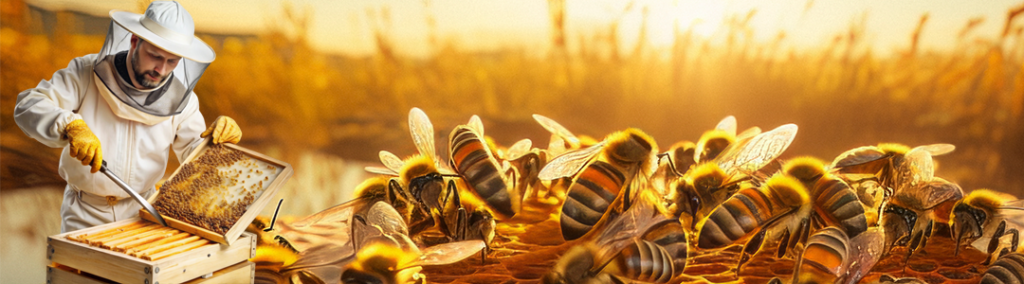
Honey-bees can navigate using the position of the sun, polarized light and landmarks. They can ‘tell’ other bees about the distance and bearing to sources of food using a well developed symbolic language based on movement and sound. They can also regulate the temperature of the nest to an exact degree using heating and cooling systems of immense complexity. As long as it has water and food, a colony placed on the sides of a volcano or iceberg will maintain its brood nest at 34º C (93º F). It is these facets of the honey-bee’s ability that have caused it to be one of the most researched insects on earth, and all countries maintain at least one institute devoted to bee research, and many universities have bee research departments.

So, could you manage to keep these highly complex creatures? The answer is yes, you could – if you knew how to, and that can be learnt from this in the nature. It is not difficult at all, as long as you know what you are doing.

Contact us Home

Related Post

  • POLLINATION

    Introduction Pollination is the transfer of pollen grains from the anther to the stigma of the same flower or another flower of the same plant or another plant but of the same species. In other words, pollination is  the mixing of the male and female parts of a flower. Pollination is a vital step in the reproduction of flowering plants and is necessary for all seed and fruit production. Plants require pollen to be transferred from one plant to another and many depend upon insects to do this as they forage. Bees play a vital role in food production and overall agricultural productivity, as pollinators. Pollination Plants require pollen to be transferred from one plant to another to aid reproduction. This transfer of pollen grains…

  • Bee Keeping in Urban Area

    Some may surprised to know why on earth beekeeper would keep bees in a city area. In fact some of best honey comes from city parks and garden and some areas richer in nectar than many areas of the crops countryside. There are main things to think about beekeeping in urban area is neighbours, neighbours and neighbours. If you want bees your neighbours don’t. The neighbours will be scared of bees because many peoples think that honey is produced by nice, bumble bees & so when they see your fast horrid little wasp like things around all over the place, they will not always be pleased or happy about it keep them happy by trying to adhere to the hive placements outlined below and always…

  • Online Beekeeping Training in India – Learn Beekeeping from Experts (March 23, 2025)

    Join Our Exclusive Online Beekeeping Training on March 23, 2025 Are you passionate about beekeeping or looking to start your journey as a beekeeper? Join our Online Beekeeping Training on March 23, 2025, and learn everything you need to know to get started! Training Details: 🌼 Date: Sunday, 23rd March 2025 🌼 Time: 9:30 AM to 4:30 PM (IST) 🌼 Mode: Online (Google Meet) 🌼 Training Fee: ₹499 This training is designed for beginners and experienced beekeepers who want to deepen their knowledge and improve their beekeeping skills. 🐝 What You Will Learn: 🐝 Fundamentals of beekeeping 🐝 How to set up and manage a beehive 🐝 Understanding bee behavior and colony management 🐝 Harvesting honey and maintaining hive health 🐝 Common challenges and how to overcome…

  • मधुमक्खी पालन के लिए कौन सा छत्ता सबसे अच्छा है?

    मधुमक्खी पालन के लिए कौन सा छत्ता सबसे अच्छा है?         पारंपरिक भारतीय छत्ता   हमारे देश में प्राचीन समय से लोग पेड़ों के खोखलों, मिट्टी के घड़ों और लकड़ी के डिब्बों में मधुमक्खियां पालते आए हैं। ग्रामीण इलाकों में आज भी इनका इस्तेमाल किया जाता है। फायदा यह है कि यह सस्ता और प्राकृतिक होता है, लेकिन इससे शहद निकालना मुश्किल हो सकता है और मधुमक्खियों को नुकसान पहुंच सकता है।   टॉप बार छत्ता   यह सरल डिजाइन और कम लागत वाला छत्ता है। इसमें मधुमक्खियां प्राकृतिक तरीके से शहद के फ्रेम बनाती हैं। शहद निकालते समय मधुमक्खियों को कम नुकसान होता है। हालांकि, बड़े पैमाने पर शहद उत्पादन के लिए यह उपयोगी नहीं होता।   न्यूक्लियस छत्ता   अगर…

  • Summer Management’s for bees

    Hi friends When we working with bees then one of the big problem is draught season. In the summer bees want many things to help them with your caretaking behavior. The hot summer season is very hard for the bees they want feeding water frequently. These are the main things you require to do in the summer Placed your bees under a tree or in a sheddow area. The water source is not away more then 500 mtrs Make sure your bee boxes well ventilated. Top cover can be slightly loose in the summer. Avoid direct heat of sunlight to saved hives melted. Don’t visit the colony boxes in the hot time. You can feed your bees inside the box by sugar syrup or water….

  • छत्ते को कम खोलना और प्रवेश द्वार से देखना क्यों फायदेमंद है-Benefits of Less Opening the Beehive and Observing from the Entrance

    छत्ते को बार-बार खोलने की बजाय मधुमक्खियों को प्रवेश द्वार से देखना एक समझदारी और मधुमक्खी-हितैषी तरीका है। इसके कई फायदे हैं: 1. मधुमक्खियों पर कम तनाव: बार-बार छत्ता खोलने से मधुमक्खियां परेशान हो जाती हैं। उनके काम में रुकावट आती है। बाहर से देखने पर वे अपनी दिनचर्या में व्यवस्थित रहती हैं। 2. तापमान और नमी का संतुलन: छत्ते के अंदर का तापमान और नमी का संतुलन बहुत जरूरी होता है, खासकर बच्चों (ब्रूड) और शहद के लिए। बार-बार छत्ता खोलने से यह संतुलन बिगड़ सकता है, जिससे नुकसान हो सकता है। 3. बीमारियों का खतरा कम: बार-बार छत्ता खोलने से बीमारियां या कीट, जैसे वररोआ माइट्स, फैलने का खतरा बढ़ जाता है। कम छेड़छाड़ करने से यह जोखिम कम हो जाता है। 4….

Leave a Reply

Your email address will not be published. Required fields are marked *