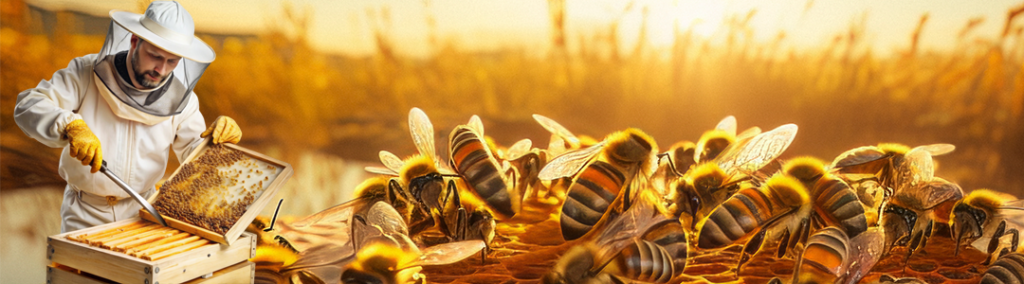
HARVESTING OF ROYAL JELLY 

Royal Jelly is a milky-white cream & strongly acid, and rich in protein, sugars, vitamins, RNA, DNA, and fatty acids. It is possibly the most valuable product of the hive and numerous, fabulous claims have been made about it. It is the food of queen bee larvae and, by feeding a worker bee larva this substance, she will develop into a Queen rather than a worker. She will be a female bee that can mate a totally different being from the Worker, despite the fact that they start out exactly the same.

For humans, Royal Jelly can be used as a food Supplement or as an addition to cosmetics to enhance their curative properties. There are numerous stories about the powers of Royal Jelly and the part it can play in human health, but most are anecdotal. In one of Roald Dahl’s Tales of the Unexpected, a character turns his baby son into a bee (or at least a black-and-yellow striped, hairy

baby) by feeding him exclusively on royal jelly. Amazing stuff! The medicinal and curative properties of the substance lack much clinical research, but what we do know is that it contains as bellow.

  • Thiamine (B1)
  • Riboflavin (B2)
  • Pantothenic acid (B5)
  • Pyridoxine (B6)
  • Niacin (B3)
  • Folic acid (B9)
  • Inositol (B8)
  • Biotin (B7)

Related Post

  • POLLINATION

    Introduction Pollination is the transfer of pollen grains from the anther to the stigma of the same flower or another flower of the same plant or another plant but of the same species. In other words, pollination is  the mixing of the male and female parts of a flower. Pollination is a vital step in the reproduction of flowering plants and is necessary for all seed and fruit production. Plants require pollen to be transferred from one plant to another and many depend upon insects to do this as they forage. Bees play a vital role in food production and overall agricultural productivity, as pollinators. Pollination Plants require pollen to be transferred from one plant to another to aid reproduction. This transfer of pollen grains…

  • History of Bee Keeping

    The Beekeeping is an ancient art that has fascinated its devotees since earliest times. Honey robbed from wild colonies in trees & caves was early people’s main source of sweet food. Dominance of honey  the major sweetener continued until cane and beet sugar became generally available in comparatively recent times. Honey with its unique flavors and aromas and natural origin still has wide appeal. World production was estimated at 1,446 million pounds in 1976 and more than 1,415 million pounds in 1977. In the United States about 200,000 people keep almost 5 million colonies and produce 200 million to 250 million pounds of honey annually. Beekeepers can be classified as full-time, sideline, or hobbyist, with the number of colonies operated by individual owners varying from one…

  • Cotton Crop for Bee Keeping

    मधुमक्खी पालन में उपयोगी है कपास की फसल   कपास की फसल में पोलन व नेक्टर दोनों की पर्याप्त मात्रा मिलती है कपास की फसल की बुआई मई के महीने में की जाती है। जिन मधुमक्खी पालकों के नजदीक कपास की खेती होती है वहां वे साथी मधुमक्खियों को रख सकते हैं। भारतीय मानचित्र में दिखाया गया है कहाँ कहाँ इसकी फसल उगाई जाती है।     जो साथी भी शहद का उत्त्पादन अधिक मात्रा में लेना चाहें उनके लिए अच्छा चुनाव है परन्तु केमिकल के छिड़काव से मधुमक्खियों को बचा कर रखने की भी आवश्यकता होती है। आजकल सभी प्रकार की फसलों में दवाइयों का छिड़काव किया जाता है जो मधुमक्खियों के लिए खतरनाक है। इससे आपकी मधुमक्खियों के मरने की अधिक संभावना होती है…

  • Summer Management’s for bees

    Hi friends When we working with bees then one of the big problem is draught season. In the summer bees want many things to help them with your caretaking behavior. The hot summer season is very hard for the bees they want feeding water frequently. These are the main things you require to do in the summer Placed your bees under a tree or in a sheddow area. The water source is not away more then 500 mtrs Make sure your bee boxes well ventilated. Top cover can be slightly loose in the summer. Avoid direct heat of sunlight to saved hives melted. Don’t visit the colony boxes in the hot time. You can feed your bees inside the box by sugar syrup or water….

  • |

    वैज्ञानिक मधुमक्खी पालन

    वैज्ञानिक मधुमक्खी पालन मधुमक्खियों के प्रबंधन और देखभाल की एक ऐसी विधि है जो आधुनिक विज्ञान, अनुसंधान और प्रौद्योगिकी पर आधारित है। इसका उद्देश्य प्राकृतिक संसाधनों का सही उपयोग करके मधुमक्खियों की उत्पादकता को बढ़ाना और उनके स्वास्थ्य को बेहतर बनाना है। इसमें पारंपरिक मधुमक्खी पालन से अलग आधुनिक तकनीकों का उपयोग किया जाता है, जैसे: • मधुमक्खी के प्रकार का चयन: स्थानीय और उन्नत प्रजातियों का चुनाव ताकि बेहतर शहद उत्पादन और रोग प्रतिरोधक क्षमता सुनिश्चित हो। • हाइव मैनेजमेंट: आधुनिक लकड़ी के बॉक्स (Langstroth हाइव) का उपयोग किया जाता है, जो मधुमक्खियों को बेहतर सुरक्षा और आराम देता है। • रोग और कीट प्रबंधन: वैज्ञानिक तरीके से मधुमक्खियों में होने वाले रोगों (जैसे वरुआ माइट) और कीटों का प्रबंधन। • फूलों और पौधों…

  • |

    भारत मधुमक्खी में मधुमक्खी पालन में आने वाली कठिनाइयाँ

    मधुमक्खी पालन में आने वाली कठिनाइयाँ मधुमक्खी पालन एक बेहद फायदेमंद लेकिन चुनौतीपूर्ण काम है। शुरुआत में कई कठिनाइयाँ आ सकती हैं, जैसे: 1. मौसम का प्रभाव: मधुमक्खियों के लिए सही मौसम का होना बहुत जरूरी है। अधिक ठंड या अधिक गर्मी से मधुमक्खियाँ कमजोर हो सकती हैं। 2. रोग और कीट: मधुमक्खियों पर वारोआ माइट्स और दूसरी बीमारियों का खतरा हमेशा बना रहता है। इनका समय पर इलाज करना जरूरी है। 3. फूलों की कमी: मधुमक्खियाँ शहद बनाने के लिए फूलों का रस इकट्ठा करती हैं। अगर आसपास फूलों की कमी हो, तो शहद उत्पादन पर असर पड़ता है। 4. छत्ते की सुरक्षा: छत्तों को चोरों, बंदरों और दूसरे जानवरों से बचाना भी एक बड़ी चुनौती हो सकती है। 5. शुरुआती जानकारी की कमी:…

Leave a Reply

Your email address will not be published. Required fields are marked *