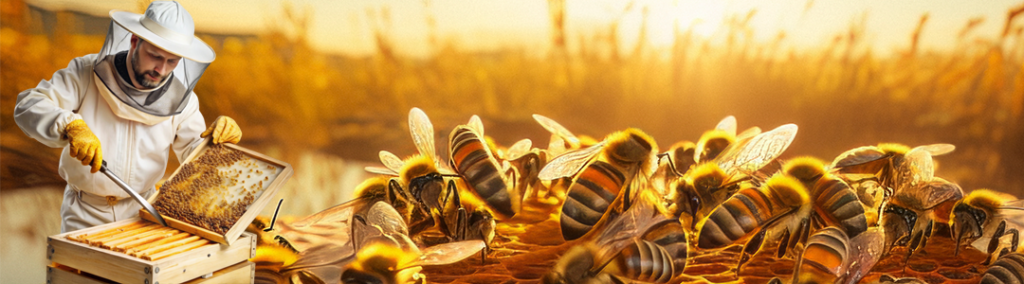
Join Our Exclusive Online Beekeeping Training on March 23, 2025


Are you passionate about beekeeping or looking to start your journey as a beekeeper? Join our Online Beekeeping Training on March 23, 2025, and learn everything you need to know to get started!


Training Details:

🌼 Date: Sunday, 23rd March 2025

🌼 Time: 9:30 AM to 4:30 PM (IST)

🌼 Mode: Online (Google Meet)

🌼 Training Fee: ₹499


This training is designed for beginners and experienced beekeepers who want to deepen their knowledge and improve their beekeeping skills.


🐝 What You Will Learn:

🐝 Fundamentals of beekeeping

🐝 How to set up and manage a beehive

🐝 Understanding bee behavior and colony management

🐝 Harvesting honey and maintaining hive health

🐝 Common challenges and how to overcome them

🐝 Business opportunities in beekeeping


How to Register?


Click the link below to register now:

Register Here


Limited seats available! Book your spot today and take the first step towards becoming a successful beekeeper.


For any queries, feel free to contact us at +91 9991240211


See you in the training!


Related Post

  • | |

    Beekeeping Beginners Training Program – Start Your Beekeeping Journey Today!

    Beekeeping is one of the fastest-growing rural income opportunities in India. Whether you want to start honey production, pollination services, or create a new source of livelihood, learning beekeeping professionally is the first and most important step. At BeekeepingIndia.in, we are committed to helping beginners start their beekeeping journey with the right knowledge, practical techniques, and expert guidance. To help new learners, we are conducting a special Beekeeping Beginners Training Program on: 📅 Date:  20th December 2025 ⏰ Time:  10:00 AM – 4:00 PM (Tea Break + Lunch Break Included) 🖥 Mode:  Online using Google App 💰 Training Fee:  ₹999 per person 🎓 E-Certificate:  Provided after completion 👉 Registration is compulsory. Register here: https://forms.gle/wpSqC4sYy9DJF5ma6   📌 Why Learn Beekeeping in 2025? Beekeeping is becoming a…

  • History of Bee Keeping

    The Beekeeping is an ancient art that has fascinated its devotees since earliest times. Honey robbed from wild colonies in trees & caves was early people’s main source of sweet food. Dominance of honey  the major sweetener continued until cane and beet sugar became generally available in comparatively recent times. Honey with its unique flavors and aromas and natural origin still has wide appeal. World production was estimated at 1,446 million pounds in 1976 and more than 1,415 million pounds in 1977. In the United States about 200,000 people keep almost 5 million colonies and produce 200 million to 250 million pounds of honey annually. Beekeepers can be classified as full-time, sideline, or hobbyist, with the number of colonies operated by individual owners varying from one…

  • How to divide a New Bee Colony

     किसी मौजूदा कॉलोनी को कैसे विभाजित करें अपनी कॉलोनियों को बढ़ाने और डिवीजन बनाने के लिए मजबूत, उत्पादक और बिना रक्षात्मक कॉलोनी चुनें। शहद के मौसम के दौरान विभाजन करने से बचें क्योंकि यह उत्पादित होने वाले धन (शहद) की मात्रा को कम कर देगा। फूलों के मौसम की शुरुआत और चरम के बीच, मजबूत कॉलोनियां अचानक प्रवेश द्वार के पास मधुमक्खियों के समूहों और ड्रोन की संख्या बढ़ जाती है जिससे आपकी मजबूत कॉलोनी का पता चलता है इसलिए चेक करें की अगर कॉलोनी स्वार्म करने की तैयारी कर रही हैं तो वह डिवीज़न के लिए उपयुक्त समय है। जब शहद की मात्रा अधिक हो और मधुमक्खियां रानी मधुमक्खियों के सेल्स बनाने लगें तब ये सभी लक्षण हैं जब आपको डिवीज़न करना चाहिए।मधुमक्खियों का…

  • Bee Keeping in Urban Area

    Some may surprised to know why on earth beekeeper would keep bees in a city area. In fact some of best honey comes from city parks and garden and some areas richer in nectar than many areas of the crops countryside. There are main things to think about beekeeping in urban area is neighbours, neighbours and neighbours. If you want bees your neighbours don’t. The neighbours will be scared of bees because many peoples think that honey is produced by nice, bumble bees & so when they see your fast horrid little wasp like things around all over the place, they will not always be pleased or happy about it keep them happy by trying to adhere to the hive placements outlined below and always…

  • Bee’s & Flower’s

    There are many types of flower’s in the nature for bee’s. Bee Keeper’s don’t know much about which types of flower’s were used by the bee’s to collect nectar & pollen. We only know little about the flower’s name & variety. In the forest bee’s goes for their food and visiting more then 2,000 flower’s a day in search of nectar & pollen. If we identify some flower’s to useful for them it will be very helpful for bee keeper’s. Bee keeper’s  migrate the bee’s from one place to another place to survival of bee’s and to collect bee products. Recognition of the site and requirements of the bee’s are useful for bee keeper’s. In the video given bellow you can understand about how to…

  • Social Behaviour of Honey Bee’s

    Among different insect orders, only 8 have been recognized by insect taxonomists which have some communal life. Out of these 8 orders only two orders viz. Isoptera and Hymenoptera have well developed social organization. Even in Hymenoptera, only two families namely Halictidae and Apidae of superfamily Apoidea contain fully social species. Most of other bees live solitary life. Social behaviour Honey bees are among the fully social insects having overlap of many generations in the same nest. The colony is a well organized social group having division of labour in terms of laying of eggs, nursing, comb building, guarding, food collection and its storage. They have well developed communication system through different types of dances as well as trophallaxis. Biological communication can be defined as…

Leave a Reply

Your email address will not be published. Required fields are marked *