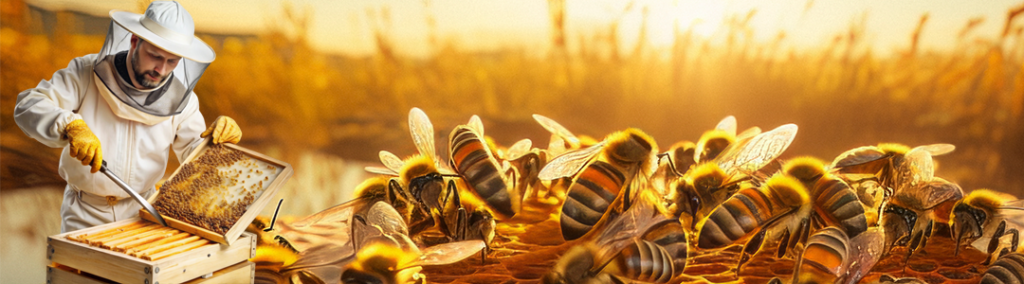
Winter season is very tough season for the bee’s to survive. In the winter season bee’s are unable to go outside to collect food due to low temperature. In this situation bee keepers need to take care or their bee colony to survive them.

Winter Management for Bee’s image-1

The main reason of bee’s not going outside is low temperature & not availability of sufficient flower’s to collect nectar & pollen outside their hive. Some technic to help them is available for bee keeper’s to help them. These technics are called as Winter Management Technic are given bellow

  • Close the top cover with air proof not to entering the snow & cold air in to the hive. If your cover is loose and space between gaps will be harmful for bees.
  • Feeding inside the bee box to give them support to have their food requirements. You can put sugar syrup, water & pollen to feed them.
  • Close all leakages in the bee box not to enter the winds and snow in the bee colony.
  • Ventilation is require if you close all the gaps please don’t forget to keep cross ventilation. fresh air must be required for good health of bees.
  • Place your bee colony to find early sun light in the morning to warm sooner to the bee’s.
For More information about Winter management please visit our video given bellow.

Related Post

  • Sunflower for Bee’s

    In the month April in northern India Haryana and punjab growing the Sunflower for oil. These states and some other states Karnataka, Maharashtra, Orissa, Bihar etc. are the measure states with sunflower growing. The bee keepers who is interested in Sunflower crops looking for honey and pollen can choose the better place for them. Sunflower is full of nectar and pollen. Bees growing very fast in these days. In the summer in some areas there is not good condition.

  • History of Bee Keeping

    The Beekeeping is an ancient art that has fascinated its devotees since earliest times. Honey robbed from wild colonies in trees & caves was early people’s main source of sweet food. Dominance of honey  the major sweetener continued until cane and beet sugar became generally available in comparatively recent times. Honey with its unique flavors and aromas and natural origin still has wide appeal. World production was estimated at 1,446 million pounds in 1976 and more than 1,415 million pounds in 1977. In the United States about 200,000 people keep almost 5 million colonies and produce 200 million to 250 million pounds of honey annually. Beekeepers can be classified as full-time, sideline, or hobbyist, with the number of colonies operated by individual owners varying from one…

  • How many days to make honey in Honeycomb?

    Knowing when to harvest Honey can be extracted when it has been capped over by the bees on the comb. At this stage, the honey will have been ‘matured’ by the bees, sealed up and is ready to eat. Often, when you want to remove the honey, not all will have been sealed. I always use a rule of thumb here if three quarters of the honey is sealed, I am happy to remove it from the hive. This is an important point. If you extract honey that has not been sealed, the water content will inevitably be too high, and the honey will ferment in storage and explode if sealed in a jar or tank. It will also taste foul if this happens. You…

  • |

    Innovative Bee Nutrition Solutions: Feeding the Future of Beekeeping

    🌼 The Buzz About Bee Health In recent years, beekeepers around the world have faced one overwhelming challenge: keeping their bees alive and thriving. Between environmental stressors, pesticide exposure, and dwindling natural forage, honey bees are struggling to get the nutrients they need. That’s where innovative bee nutrition solutions step in — not just as supplements, but as lifelines for the future of beekeeping. 🍯 Why Nutrition Matters More Than Ever Healthy bees require a balanced diet rich in protein, lipids, and micronutrients—primarily sourced from pollen. But with monoculture farming, climate change, and habitat loss reducing natural floral diversity, bees are often left hungry or malnourished. Poor nutrition = weaker bees = higher colony loss.It’s a simple equation with devastating consequences. 🧪 Pollen Substitutes: A…

  • Strange fact About Bee’s

    Honey-bees can navigate using the position of the sun, polarized light and landmarks. They can ‘tell’ other bees about the distance and bearing to sources of food using a well developed symbolic language based on movement and sound. They can also regulate the temperature of the nest to an exact degree using heating and cooling systems of immense complexity. As long as it has water and food, a colony placed on the sides of a volcano or iceberg will maintain its brood nest at 34º C (93º F). It is these facets of the honey-bee’s ability that have caused it to be one of the most researched insects on earth, and all countries maintain at least one institute devoted to bee research, and many universities…

  • Benefits of Mushroom Cultivation

     मशरूम का उपयोग प्राचीन काल से भोजन के रूप में किया जा रहा है। इन्हें बहुत ही कोमल माना जाता है। पोषण के दृष्टिकोण से मशरूम को मांस और सब्जियों के बीच रखा जाता है। इनमें प्रोटीन, कार्बोहाइड्रेट और विटामिन्स भरपूर मात्रा में होते हैं। मशरूम कैलोरी में कम हैं और इसलिए दिल और मधुमेह रोगियों के लिए सर्वोत्तम हैं। मशरुम अनाज, फल और सब्जियों की तुलना में बेहतर हैं इनमें ताजा वजन के आधार पर प्रोटीन (3.7%) के अलावा कार्बोहाइड्रेट (2.4%), वसा (0.4%), खनिज (0.6%) और पानी (91%) है । मशरूम में मानव विकास के लिए सभी आवश्यक नौ अमीनो एसिड होते हैं। मशरुम थायमिन (विटामिन-बी 1), राइबोफ्लेविन (बी 2), नियासिन, पैंटोथेनिक एसिड, बायोटिन, फोलिक एसिड का स्रोत है, विटामिन सी, डी, ए और…

Leave a Reply